

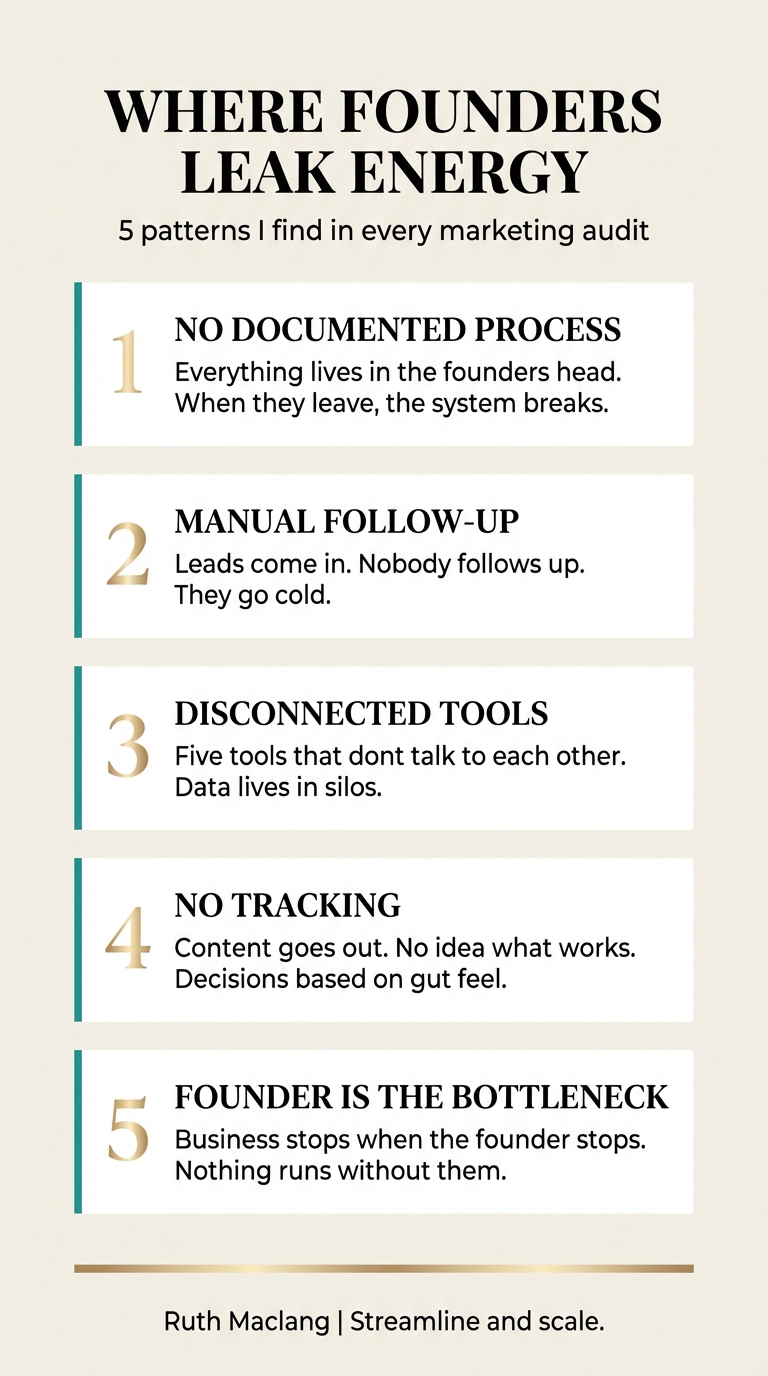
What Your Marketing Audit Will Actually Reveal
Most founders think they have a strategy problem.
They want a new framework. A better funnel. More channels. More traffic. More visibility.
When I do a marketing audit with a client, I’m not looking at the strategy deck. I’m listening for where the energy leaks.
How they talk about the work. Where frustration shows up. Which part of the business makes them want to hide. The answer is almost always the same: the business was built for who the founder was three years ago. Not who the business needs to be now.
The system needs an update. The founder needs permission to say it out loud.
What a Systems Audit Looks Like
Let me walk you through how I actually do this.
A founder came to me last month. Let’s call her Maya. She had a product. It was good. Customers loved it. But revenue was stuck. She was working harder every month and making the same amount of money.
She thought the problem was traffic. “I need more leads,” she said. “My conversion is fine, but I don’t have enough people in the top of the funnel.”
Standard founder problem. You can see why she thought that.
So I asked her to walk me through her actual week. What does a normal day look like? Where do you spend your energy? What part of the business, if it disappeared tomorrow, would make you cry? What part would make you relieved?
That’s when it got honest.
She spent 30 percent of her time on customer support. Not because her business needed it. Because she was the only one answering emails. She spent 20 percent of her time writing custom proposals instead of using a template. She spent 15 percent of her time managing a contractor who wasn’t delivering. She spent another 15 percent worried about all of the above.
That’s 80 percent of her week on stuff that didn’t scale.
The remaining 20 percent was actual strategic work. And that was the traffic. The marketing. The thing that was supposed to grow the business.
So I asked her: “If you hired someone to handle support, used a template for proposals, and fired the contractor, what would you actually do with that time?”
She stopped. She got quiet. Then she said something I hear a lot: “I don’t know. I’ve been so busy managing the problems that I forgot what I was supposed to be building.”
That’s the real problem.
The Energy Leak
The strategy deck says: “Grow traffic.”
The actual system says: “Every customer who comes in requires personal founder attention. The founder is at capacity. More customers means more stress, not more revenue.”
That’s an energy leak.
It’s not a marketing problem. It’s a business design problem. You can’t solve it with better ads. You can’t solve it with a new funnel. You have to solve it by redesigning what work the founder does and what work the system does.
When I said that to Maya, something shifted. She didn’t need more leads. She needed fewer things to manage so she could focus on the leads she already had.
Here’s what we built:
- Support email templates + canned responses (contractor to handle most of it)
- Proposal template with pricing options (founder picks one instead of writing custom)
- Documented contractor deliverables (founder audits instead of manages)
- Clear email boundaries (founder checks email at 10 AM and 3 PM, not constant)
That took two weeks to set up. Three weeks to train the contractor. One month in, she had 40 percent of her week back.
Then I asked her again: “What do you do with this time?”
She wrote a content strategy. She rebuilt her funnel. She reached out to 10 past customers about referrals. She published a guide that attracted inbound leads.
That content strategy brought in 3X the leads she was getting from ads. For free. Because she finally had time to think.
The marketing audit revealed that her problem wasn’t traffic. Her problem was that the founder was doing junior-level work that a junior person could do.
Where Frustration Shows Up
This is what I’m actually listening for in an audit.
Not: “Is your strategy good?”
But: “Which parts of your business make you want to scream?”
When someone starts complaining about a process, they’re pointing at an energy leak.
- “I hate doing customer onboarding.” → You should hire someone. You’re slowing down the customer experience and wasting founder time.
- “I can’t keep up with my email.” → You have a communication system problem. You need automation or delegation.
- “This client keeps asking for changes.” → You need better boundaries or a contract redesign, not better project management.
- “I’m burnt out.” → Your business is designed around you instead of around systems.
The frustration is a gift. It’s telling you exactly where the system is broken.
Most founders try to fix frustration by working harder at the thing that frustrates them. So they get better at handling email. Better at managing the difficult client. Better at customer support.
That’s not fixing the problem. That’s accepting it.
The real fix is to remove the task from your lane entirely or to automate it.
The Business Built for Yesterday’s Founder
Here’s the thing that breaks my heart.
Most founders built their business in a way that made sense when they started.
Founder does everything. That works when you have no budget. You’re scrappy. You move fast. You’re solving the problem yourself.
Then the business grows. You make money. You can afford to hire people.
But nobody stops and says: “Now that I have budget, what should I stop doing?”
Instead, they layer people on top of the old system. They hire someone to help with support but keep overseeing it. They hire a contractor but spend as much time managing the work as the work would take. They hire a marketer but keep writing blog posts.
The business now has the overhead of a real company but the decision-making of a solo founder. Worst of both worlds.
When I do an audit, I’m looking for this. Where is the founder doing work that doesn’t require founder expertise? That’s the gap between who the founder is now and who the business needs them to be.
A founder who can code could hire engineers and become a product leader. But they’re still debugging code every Tuesday.
A founder who’s great at sales could hire a sales team and become a strategist. But they’re still doing demos.
A founder who’s excellent at marketing could hire marketers and become a thought leader. But they’re still writing social media posts.
The business is held back not by a strategy problem. By a role definition problem.
How I Present This to Founders
When I do an audit, here’s how the conversation usually goes.
I say: “Your strategy is fine. Your traffic goal is realistic. The problem is your time.”
Usually they argue. They say: “No, I need more leads. If I had more leads, this would work.”
So I walk them through the math. “You can close X. To close more, you need Y. You’re already spending Z time on delivery. More leads means more delivery time. You’re at capacity. More leads don’t fix the problem. More systems do.”
That’s when it lands.
Then I ask: “If you had to choose—more leads or more freedom—which would you pick?”
Every founder picks freedom. But nobody says it first. Because everyone thinks they should want more growth, not more breathing room.
They should want both. And you get both when you fix the system instead of adding more to it.
FAQ
Isn’t this just delegation?
Delegation is part of it. But delegation assumes someone else is the right person. Sometimes the real answer is to remove the task entirely. Do you actually need customer onboarding calls? Could customers self-serve? Do you actually need custom proposals? Could they pick from templates? Delegation is one answer. Elimination is often better.
What if I’m the only person who can do this task?
No, you’re not. You’re just the first person who did it. If you take the time to document how you do it, train someone, and give them permission to do it their way, they can do it. The belief that only the founder can do important work is usually the actual bottleneck.
How do I know if something is an energy leak or just part of the job?
Ask yourself: Does this task require my specific expertise, or does it require someone reliable? Can someone else make the decision, or do I actually need to? If you feel like you’re the only one who can do it, but you also hate doing it, it’s an energy leak. If you love doing it and only you can, it’s actually part of your job.
What if fixing the system costs more than I’m making?
Then you’re not ready to grow. And that’s fine. But own that decision. Don’t pretend you want to grow while staying stuck in solo-founder systems. The cost of staying small is usually burnout. The cost of growing is usually hiring someone. Pick which cost you can live with.
How much time should I spend on this audit myself?
I’d recommend a week. Maybe two if you have a lot of moving parts. Block time to really think through where your energy goes. Write down everything you do. Mark what requires your expertise and what doesn’t. You’ll see the gaps immediately.
Want to know the highest ROI to automate in your business? Book a complimentary 30-min consultation. I’ll look at what’s manual, what’s automatable, and what it’s costing you.
About the author: Ruth Maclang builds AI-powered department systems for founders through StreamLab AI. Marketing, sales, ops—built once, runs lean. Connect with Ruth on LinkedIn or book a complimentary consultation at calendly.com/ruth-streamlabai/30min.
_This is The Receipts #11. Every week, I share a story from my career and the systems lesson buried inside it. Not advice. Proof._
Leave a Reply