
TL;DR: Your business is probably running on one person’s memory, not your systems. We’ll show you what that looks like, why it’s costing you, and the simple documentation approach that actually sticks.
The CRM That Wasn’t a CRM
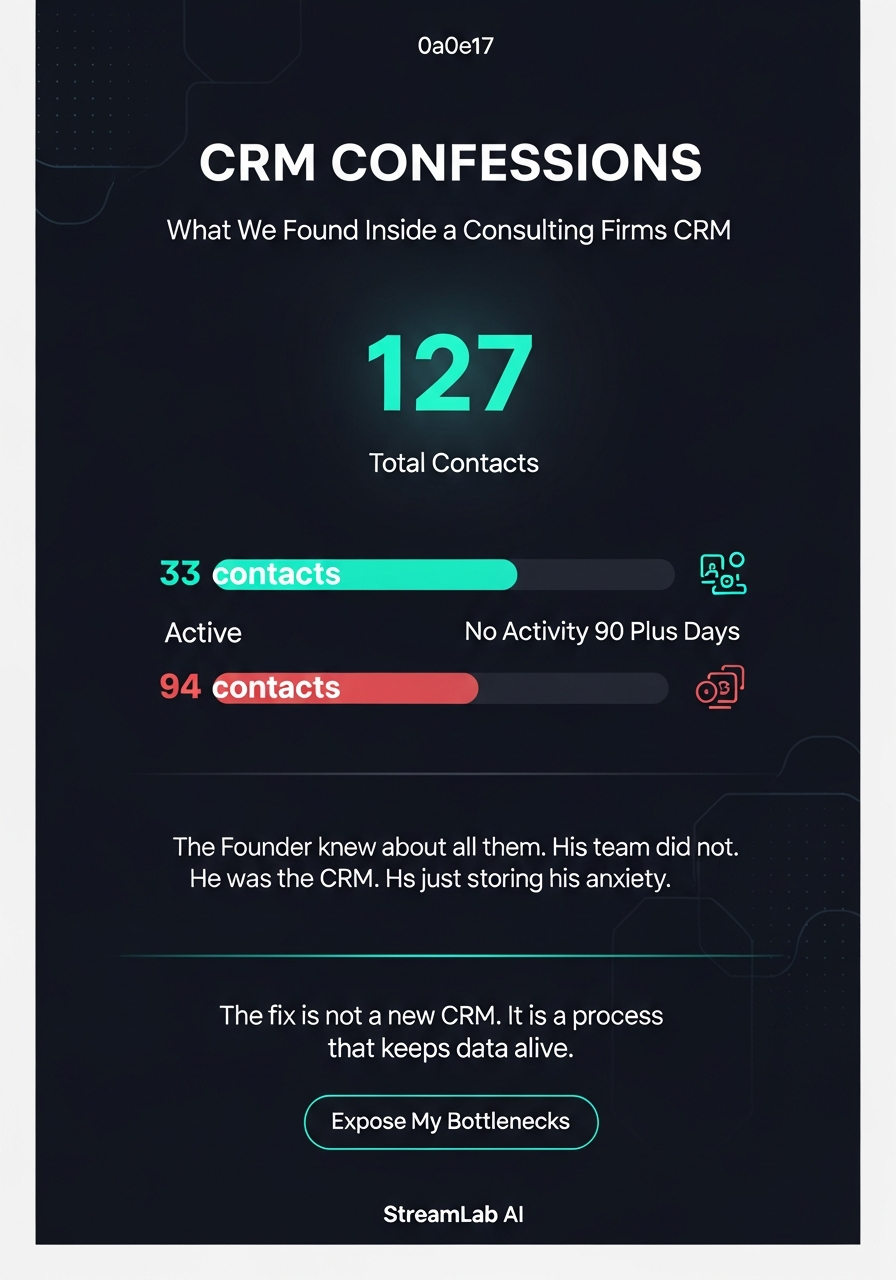
We opened a consulting firm’s CRM last month. 127 contacts. 94 had no activity in 90 days.
The founder knew every single one of them. Their histories. Their problems. Which conversations were hot. Which ones had gone cold. All of it, in his head.
His team? They had names and email addresses.
The CRM wasn’t a customer relationship management system. It was a filing cabinet for the founder’s anxiety. A place where information went to sit and gather dust because the real relationship management was happening in one person’s mental model.
That founder couldn’t take a week off. Not because the team didn’t care. But because nobody else could pick up a call from an old contact and know what had happened last time or what they’d said they’d do next.
This isn’t rare. This is normal.
The Source-of-Truth Problem
Here’s another real one: a founder managing 12 key clients across three CRMs, a project management tool, and two spreadsheets.
Not because he was disorganized. Because he was trying to solve the same problem five times and none of the tools felt trustworthy enough to be the only one.
CRM had contact records but no project timeline. PM tool had tasks but no deal status. First spreadsheet tracked revenue. Second spreadsheet tracked contract renewal dates. Nobody wanted to be the person who put critical information in the wrong place and cost the company a renewal.
So information multiplied. Spread across systems. Got out of sync. And the founder became the only person who knew which system had the real answer.
That’s key person risk dressed up as a tools problem. It’s not. It’s a visibility problem.
What Key Person Risk Actually Looks Like
Key person risk isn’t just “what if the founder gets hit by a bus.” That’s the dramatic version.
The real version is smaller and more expensive:
- A client issue takes 3x longer to resolve because only one person knows the full context
- Revenue leaks because nobody else knows which leads are warm
- Hiring slows down because the founder is the only person who understands how decisions get made
- Scaling plateaus because every major decision needs the founder’s input
- A new hire takes 6 months to get up to speed when they should take 6 weeks
This is death by a thousand cuts. It’s not obvious. It’s not dramatic. It just slowly caps how much the business can grow.
The “Week Off” Test
Here’s how you check if your business has key person risk:
Take a week off. A real week where you don’t check email, don’t take calls, don’t advise the team.
Now ask: what got stuck? What decisions didn’t get made? What customer got half-answered because the team didn’t have context?
If the answer is “nothing, the team kept going,” you probably don’t have key person risk.
If the answer is “the usual stuff delayed, one client got annoyed, a decision got punted,” you do.
Most founder-led businesses fail that test.
Why Documentation Usually Fails
This is where people say “you need better documentation.”
Most founders try. They write 50-page SOPs. They dump process docs into a folder nobody reads. They build a Notion wiki and hope someone uses it.
Six months later, nobody’s reading it. Nobody’s updating it. And the founder is back to being the source of truth.
Here’s why: documentation fails when it’s about recording what you do. It wins when it’s about making decisions repeatable.
The difference is small and critical.
Recording what you do: “Here’s how we onboard clients.” (50 steps) Someone reads it once, then follows their own intuition next time.
Making decisions repeatable: “If a client asks X, the answer is always Y because of reason Z.” Someone can make the call without asking.
One is an archive. One is a tool.
The Fix: Documentation That Actually Works
The fix has three parts. None of them require a new tool.
1. Document decisions, not steps.
Write down the rules, not the routine. “If a prospect has less than $50K annual revenue, we recommend the starter plan because their payback period is 8 months” beats a 47-step onboarding checklist.
2. Update it when decisions change.
Not every month. Not on a schedule. When you make a decision that affects how your team operates, update the doc. That’s it.
3. Let people ask questions, in writing.
When someone asks “why do we do it this way?” don’t just tell them. Write the answer down and add it to the decision doc. Next person doesn’t need to ask again.
This takes 2-3 sentences per decision. Not hours of documentation work. Just clarity about why you do what you do, written down where your team can find it.
Start with the 10 decisions that block people most often.
Frequently Asked Questions
Doesn’t this just create busy work for the founder?
No. You’re already explaining this stuff. You explain it in Slack. You explain it in meetings. You explain it on calls. Writing it down takes the same time, but happens once instead of fifty times.
What if the business changes fast and the documentation gets out of date?
Then update it. Your docs don’t need to be perfect. They need to be more current than your team’s collective memory. “Here’s why we do this, dated March 2026” is better than five different people thinking five different things.
How do I know which decisions matter enough to document?
Watch your Slack and email for a week. Which questions show up more than once? Those are the decisions that matter. Start there.
My business is too small for this. Do I really need to worry about key person risk?
If you have even one person depending on you to make sense of how things work, you have key person risk. And that means you have a scaling ceiling. The documentation approach here costs almost nothing to start. For help with marketing execution or a specific inquiry workflow, discuss the scope with StreamLab AI. Book a marketing call
Leave a Reply