
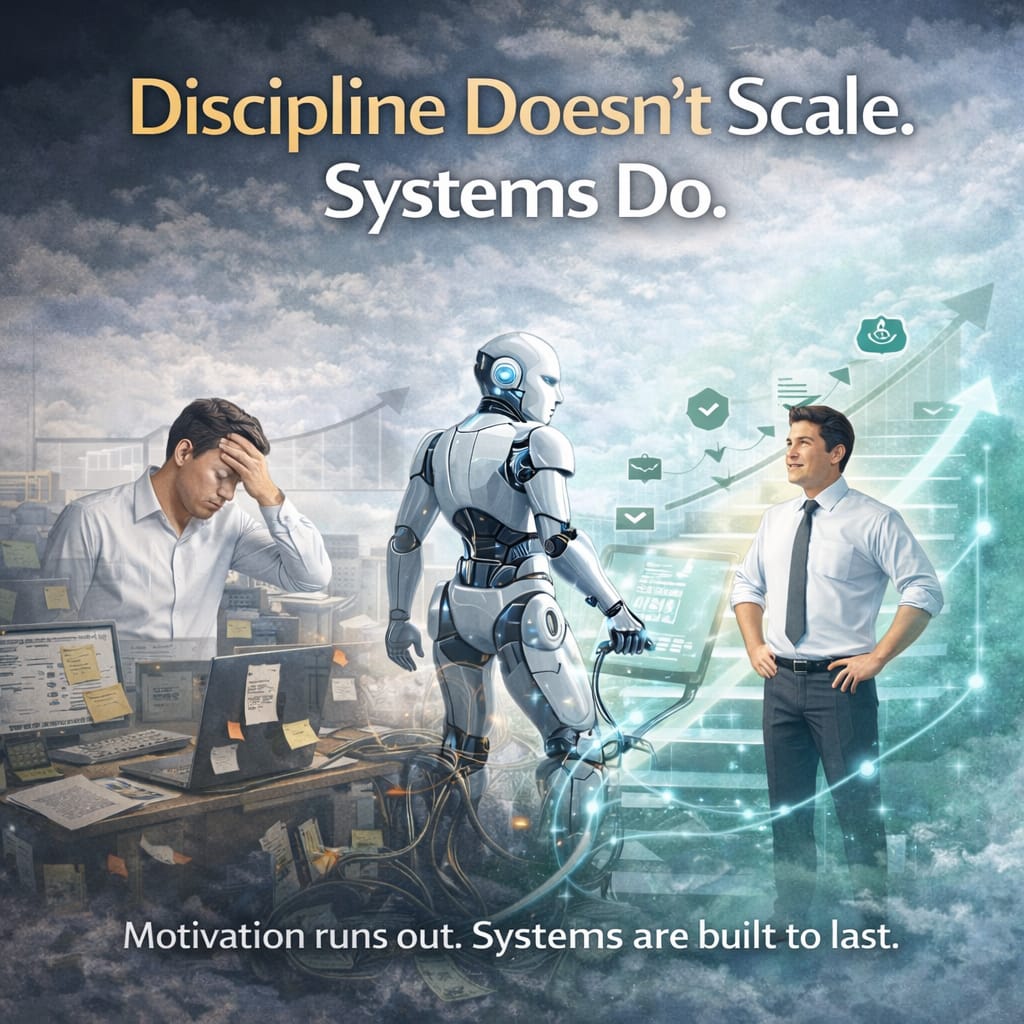
TL;DR: A business that runs without you isn’t something you stumble into after enough growth. It’s something you design deliberately — starting with documented processes, clear decision rights, and automated handoffs. Hiring more people without fixing the underlying design just creates a bigger version of the same problem.
You canceled the vacation. Again.
Not because you don’t want to go. Not because you can’t afford it. You canceled it because you know what happens when you leave: things fall through the cracks, decisions get stalled, and you come back to a mess that takes two weeks to clean up.
So you stay. You keep showing up, putting out fires, being the answer to every question. You built something real — but somewhere along the way, you became the engine it runs on.
That’s not a motivation problem. It’s an operations problem. And learning how to build a business that runs without you starts with understanding the difference.
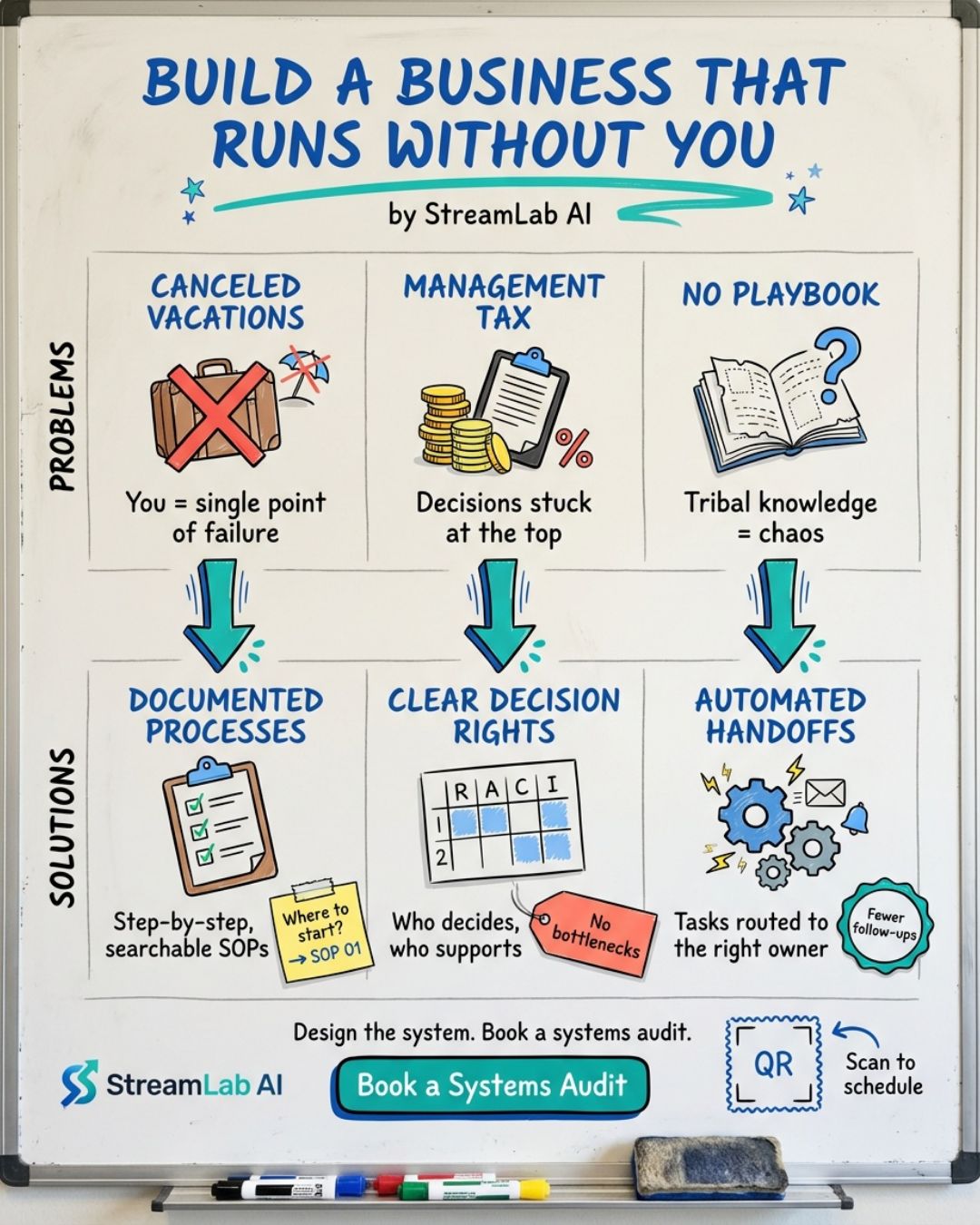
Infographic: How to Build a Business That Runs Without You
The Myth of “Just Hire Someone”
The first answer most founders reach for is headcount. If I’m stretched thin, I need more people. Makes sense on paper.
But here’s what actually happens: you hire someone, and now you’re managing them. You’re answering their questions, reviewing their work, and making decisions on their behalf because the playbook only exists in your head. You didn’t remove yourself from the operation — you added a layer.
Hiring can solve a bandwidth problem. It cannot solve a systems problem.
A business that depends on you to function doesn’t become independent just because more people are involved. It becomes a bigger version of the same bottleneck.
What “Design Before You Delegate” Actually Means
A business that runs without you isn’t something you stumble into after enough growth. It’s something you architect deliberately.
What that actually means: every repeatable decision, process, and handoff in your business needs to be designed to work without your involvement in the moment. Not “I’ll document it eventually.” Designed — meaning someone sat down, mapped the flow, identified where judgment is required, and built a system that handles it consistently.
Think of it like a flight checklist. Pilots don’t run through the checklist because they might forget. They run through it because the system doesn’t trust memory or mood. It assumes human variability and removes it from the equation.
Your business needs the same logic. Not “I trust my team to figure it out.” But: here is the exact sequence of steps, here is what good looks like, here is what to do when X happens, and here is who decides what.
When that infrastructure exists, your presence becomes optional — not because people don’t need direction, but because the direction is already built in.
What a Business That Runs Without You Actually Looks Like
A business that genuinely runs without you has a few things in place:
Documented processes for recurring work. Not vague SOPs that live in a shared drive no one opens. Actual step-by-step flows that a new team member could follow on day one without asking you ten questions.
Clear decision rights. Your team should know which decisions they own, which decisions need sign-off, and what criteria to use. If everything routes back to you, you haven’t delegated — you’ve just outsourced the prep work.
Automated handoffs. The transitions between tasks, people, and stages of a project are where things fall apart. Automating those handoffs — confirmations, reminders, status updates — means fewer things drop and fewer people need to ask you what comes next.
Systems that work regardless of who’s having a bad week. The goal isn’t a team that performs when motivated. It’s a system designed to produce consistent output independent of anyone’s mood, energy, or availability on a given Tuesday.
This is not about removing people. It’s about removing unnecessary dependence on any single person — including you.
Where Most Founders Get Stuck: Automating Before Diagnosing
The mistake is jumping straight to tools. You buy software, set up automations, and connect your apps — but none of it sticks because the underlying process was never clean to begin with.
Automating a broken process just makes it break faster.
Before you automate anything, you need to know exactly what’s happening in your business right now — where the work lives, where it slows down, and where it depends on you unnecessarily. That diagnosis comes first. The tools come after.
This is the sequence that actually works:
Step 1: Map the current state (where are you the bottleneck?)
Step 2: Fix the process design (what should happen without you?)
Step 3: Add automation where it creates real leverage
Step 4: Measure and refine
Most founders skip steps 1 and 2 and wonder why step 3 doesn’t stick.
How StreamLab AI can help with your marketing
StreamLab AI provides done-for-you marketing for established service businesses. Back Office connects content, website improvements, and marketing follow-up within an agreed scope. AI search visibility and marketing automation projects are also available. Explore the services and scope or book a marketing call.
Frequently Asked Questions
What does it mean for a business to “run without you”?
A business that runs without you is one where core operations — sales follow-up, client delivery, financial tracking, team decision-making — happen through documented systems and automations rather than through the founder’s direct involvement. The founder can step away without things stalling because the process design, not the founder’s presence, is what drives execution.
How do I start building a business that runs without me?
Start with a diagnosis, not a tool. Map where you are currently the single point of failure — in revenue, delivery, and financial operations. For each area, ask: what has to go through me, and does it actually need to? Build documentation and automation for the highest-friction areas first. Get the process right before you add tools on top of it.
Is hiring the best way to remove myself as a bottleneck?
Hiring is often the first instinct, but it’s rarely the first fix. If your processes aren’t documented, a new hire just adds management overhead — they need your input to do their job. The right sequence is to fix the process design first, then hire into a role with clear expectations and documented workflows. That’s when hiring actually reduces your involvement instead of adding to it.
What types of business processes can be automated in a founder-led business?
Lead follow-up, proposal generation, onboarding checklists, project handoffs, status updates, invoice reminders, financial reporting, client check-ins, and task routing are all strong candidates for automation in a founder-led business. The prerequisite is a clean process design — automation should execute a well-defined workflow, not compensate for a missing one.
What is StreamLab AI and how do they help founders?
StreamLab AI provides done-for-you marketing for established service businesses. Back Office connects content, website improvements, and marketing follow-up within an agreed scope. AI search visibility and marketing automation projects are also available. Explore the services and scope or book a marketing call.
Leave a Reply