
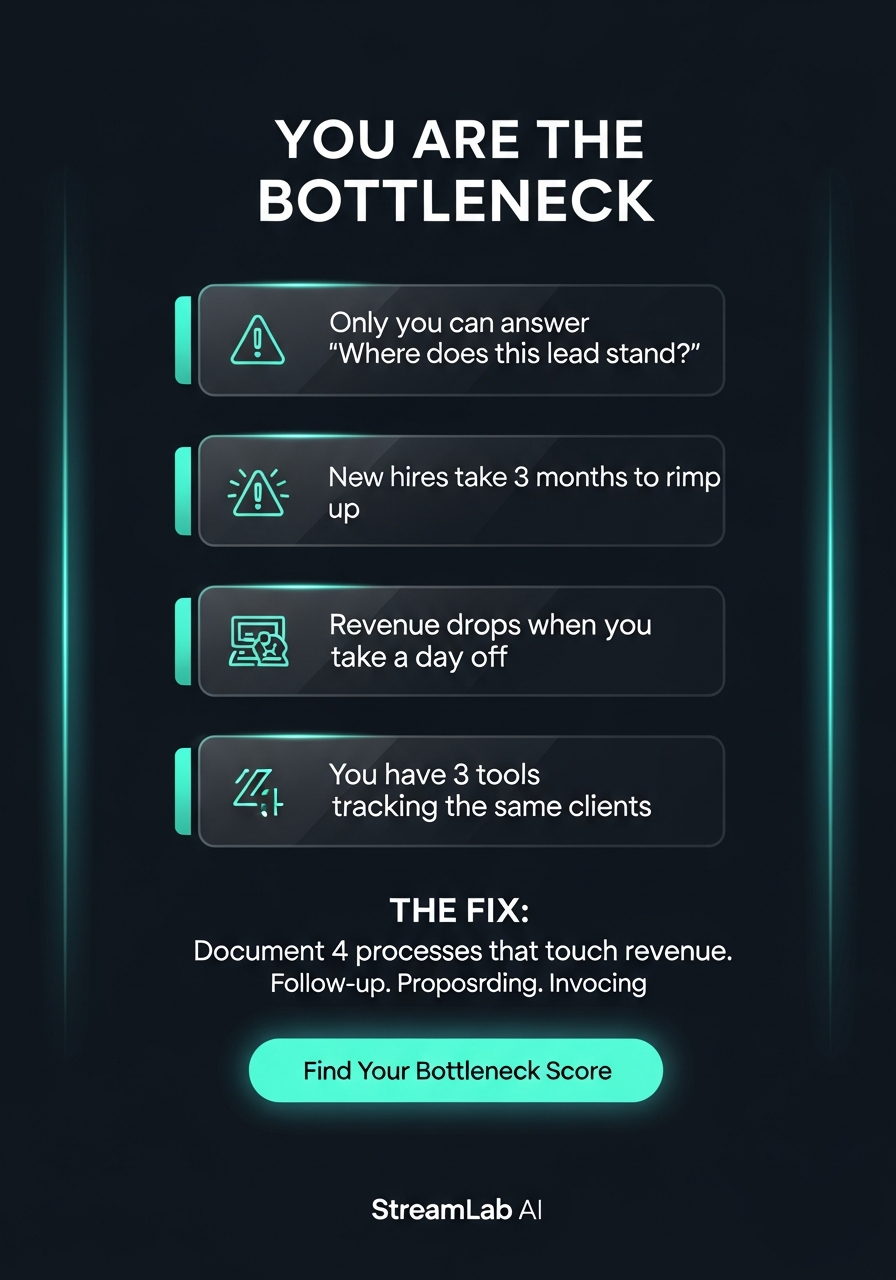
TL;DR: You’re not the bottleneck because you’re the only one who works hard. You’re the bottleneck because your team doesn’t have a playbook. Document 4 revenue-touching processes (follow-up, proposal delivery, onboarding, invoicing), assign clear ownership, and your team stops waiting for you. Automation comes after clarity, not before.
The Problem: You’re the System
You built your business. So when a lead comes in, your team looks at you. When a proposal needs to go out, your team asks you. When something breaks, your team stops.
This isn’t because they’re incompetent. It’s because you’re the system. The processes, the decision rules, the priorities, the next steps all live in your head.
Your team isn’t lazy. They’re blocked. And every time they get blocked waiting for you, revenue stalls.
You know this. You feel it every time you take a day off and come back to 40 messages. You know it when a lead goes cold because nobody else knew when to follow up. You know it when a client onboarding takes twice as long as it should because the steps aren’t written down.
The math is simple: if your business can’t move without you, it can’t grow. And if it can’t grow, you’re stuck trading time for money forever.
Find out if you are the bottleneck with our free quiz.
Why Automation Alone Doesn’t Fix It
Here’s what most founders do: they build automation. Zapier workflows, custom integrations. Lead comes in, it goes into the CRM. Proposal template auto-generates. Invoice auto-sends.
Smart move. But there’s a catch.
A founder I worked with spent 6 months building a lead capture and scoring system. Beautiful setup. Lead comes in, gets routed to the right person, scoring updates automatically. His team should have been unstoppable.
But the first week it went live, nothing happened. Leads were being scored perfectly. But when a high-value lead surfaced, his team froze. Nobody knew what to do. Was this lead ready to pitch to? Should someone call them? Who owns follow-up? What’s the play if they ghost?
The automation exposed a gap. It didn’t fill it.
He stopped, stepped back, and did the actual work: wrote down what happens to a lead at each stage. Who talks to them. When. What they say. What “ready to pitch” actually means. How many follow-ups before we move on.
Then he showed his team the playbook.
A week later, the automation was powering a real system. The team knew what to do. They didn’t wait for him. Leads moved. Revenue moved.
The automation worked because the team had clarity. Automation without process is just busy work.
Four Signs You’re the Bottleneck
Not sure if this is your problem? Here are four clear tells.
You’re the only one who can answer “where does this lead stand?”
Your team doesn’t have a master view of a deal. So they ask you. You’re in 17 conversations, you know where everything is, and you’re the source of truth. That’s not scalable. It’s you, plus a spreadsheet, plus memory.
New hires take three months to ramp.
Not because they’re slow. Because you don’t have onboarding docs. They learn by watching you, asking questions, failing quietly, and eventually figuring it out. Every new hire starts from zero.
Revenue drops when you take a day off.
Not because nothing gets done. But because the team slows down. Decisions wait. Follow-ups get delayed. Clients feel the lag. You come back to deals that got cold.
You have three CRMs and no single source of truth.
One person uses Notion. One uses a spreadsheet. One uses the CRM. Leads live everywhere. Nobody knows the real status of anything.
If you see yourself in two or more of these, you’re the bottleneck.
The Fix: Document Four Processes
You don’t need to document everything. Just the four that touch revenue.
1. Lead follow-up
When a lead goes silent, what happens? Who reaches out? How many times? What do they say? After how long do we move on?
Write it down. “If a lead hasn’t replied in 3 days, owner sends email (template here). If no reply in 7 days, owner calls. If no callback in 3 days, we move to nurture sequence.”
Your team now knows the play. They execute without asking.
2. Proposal delivery
A prospect is qualified. Now what? Who sends the proposal? When? What’s in the email? Are there follow-up dates built in? If they don’t sign in 5 days, who chases?
Write the email template. Write the follow-up sequence. Write who owns what.
Now proposals don’t sit. They move.
3. Onboarding
A deal closes. The client is excited. Then what? Who’s their point of contact? What’s week one look like? When do they get the kick-off call? What do they receive first?
Write it down step by step. Day 1, day 3, day 7, week two. Each step assigned. Each step templated.
New clients feel momentum. Churn goes down. Your team doesn’t have to reinvent onboarding every time.
4. Invoicing and follow-up
Invoice goes out. When? Who sends it? What’s the due date? If payment is late, who sends reminder 1? How many days? How many reminders before escalation?
This is the most ignored process. And it’s why you’re chasing payments 60 days out.
Write the sequence. Automate the sends. Assign the follow-ups.
What Happens After
Once these four are documented and owned, three things shift.
Your team moves without waiting. They have a playbook. They know the next step. They don’t need you to validate every decision.
New hires ramp in weeks, not months. They read the playbook. They shadow one deal. They move.
You surface faster. With the team moving predictably, you see the real problems: are proposals taking too long? Are clients churning? Is follow-up actually working? Now you’re not putting out fires. You’re optimizing systems.
This is when you bring in automation. Not before.
Your CRM works best when your team uses it the same way. Automation scales a system. It doesn’t create one.
Frequently Asked Questions
Won’t my team just ignore the playbook?
Only if it’s a wall of text nobody asked for. Real playbooks are short, specific, and use templates. Show your team how using it saves them time. Have them use it on the first deal. Then it sticks. It becomes the easiest way, not a rule.
What if my processes are different for each client?
Write the core steps, then the variations. “Here’s the default follow-up sequence. If it’s a retainer client, skip step 2. If it’s a one-off project, add step 5.” Most of your business is standard. Write that down. The edge cases your team will ask about anyway.
How long does this take?
Expect two to four weeks to document and test four core processes. That’s a few hours a week writing it down, then watching your team use it and refining. It’s the best investment of time you’ll make.
Should I use automation before or after I document processes?
After. Automate clarity. A founder I work with through StreamLab AI learned this the hard way. They had a messy follow-up process, so they built a Zapier workflow to automate it. The workflow just automated the mess. Once we documented a real follow-up sequence, then built automation around it, leads started moving. Automation is a tool to enforce good process, not a substitute for having one.
The Real Bottleneck
You’re not the bottleneck because you’re the only one who works hard. You’re the bottleneck because your team doesn’t know what to do when you’re not around.
Fix that. Write down four processes. Assign ownership. Watch your team move.
That’s how you stop trading time for money and start building a business that runs.
Leave a Reply