
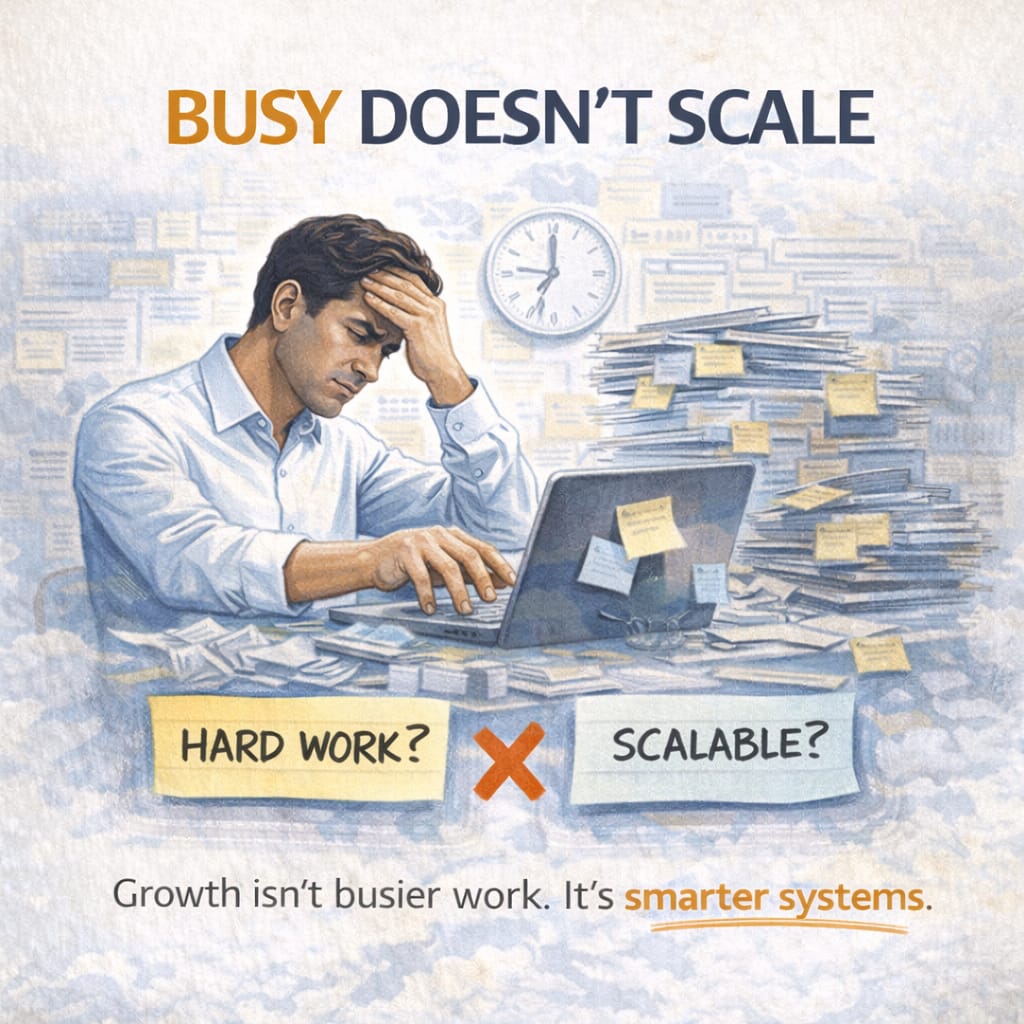
TL;DR: Most founder-led businesses run on the founder’s energy and motivation. When motivation dips — and it always does — the business slows with it. The fix isn’t better habits or a stronger morning routine. It’s building business systems that run independently of how you feel on any given day.
Everyone talks about staying motivated. Podcasts, books, morning routines, cold plunges. The whole personal development industry is built on the idea that if you just feel it enough, you’ll do it.
But here’s the problem: motivation is mood. And mood is unreliable.
You know this already. You’ve had weeks where you were fired up, and weeks where getting out of bed felt like a negotiation. The question isn’t whether those weeks happen. They will. The question is: what do your business systems do when they do?
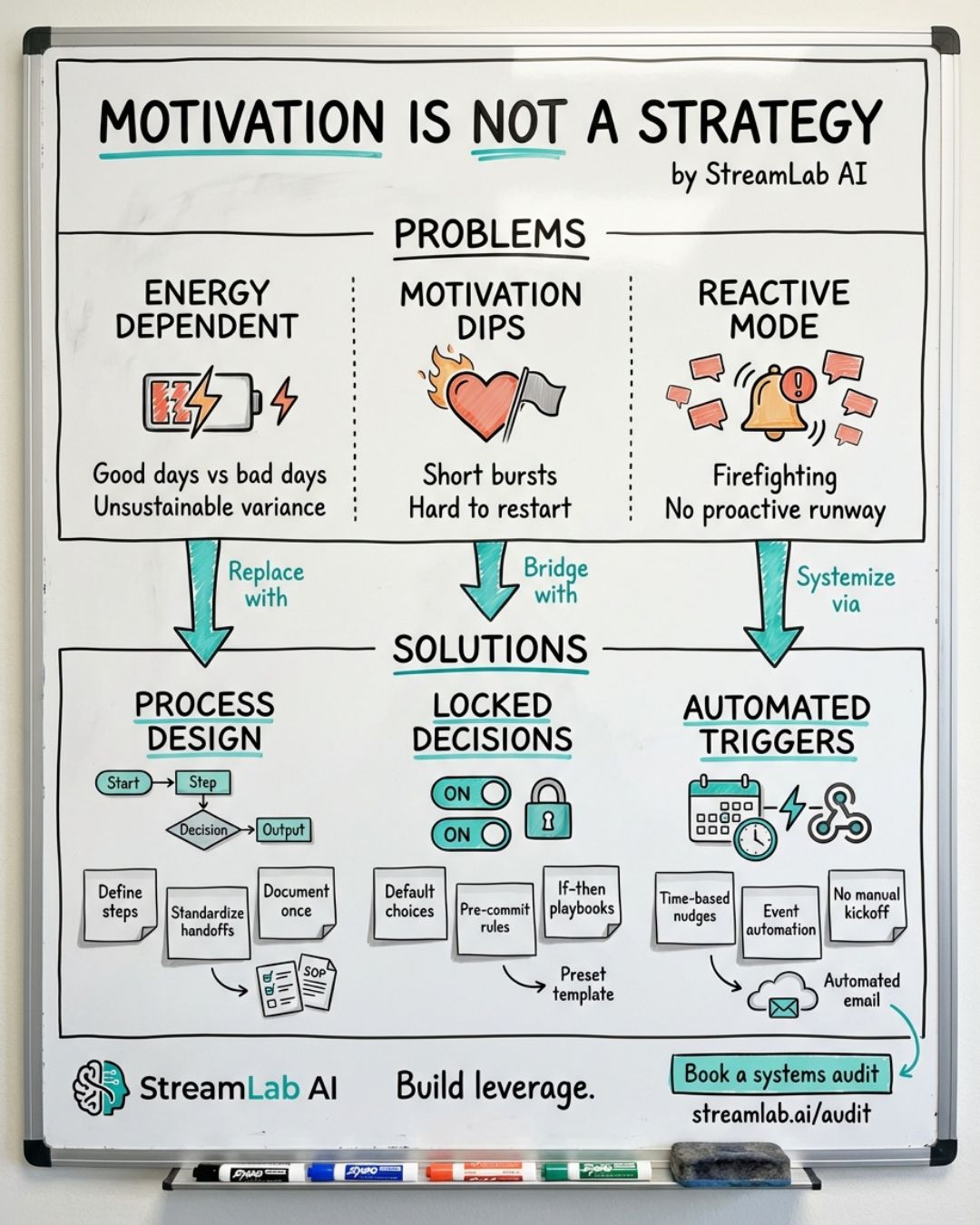
Infographic: Motivation vs System Design
What Is a Founder-Powered Business (and Why It’s a Problem)
A founder-powered business is one where operations depend on the founder’s direct energy, attention, and presence to function at full capacity. When the founder is on, things move. When the founder is off, things stall.
This is the default state for most businesses between $500K and $2M in revenue. The founder built everything, knows everything, and is still the engine everything runs through.
It works fine at the start. It becomes a trap as you scale.
Think about what happens when you get sick. Or you take a vacation. Or you have a bad week — and “bad week” doesn’t have to mean anything dramatic. It can just mean you’re tired, distracted, or dealing with something at home. Does the business keep running at the same level? Or does it quietly slow down because you’re not there to push it?
If the answer is the second one, your business isn’t a business. It’s a job that depends on you showing up charged.
Why Motivation Fails as a Business Strategy
The fix people reach for is usually a productivity hack. A new calendar system. A better morning routine. More accountability.
These help at the margins. But they’re still trying to solve a motivation problem, which means they only work when you’re already in the right headspace to use them.
Business systems work differently. A system doesn’t ask how you’re feeling.
Think of it like a dishwasher versus hand-washing dishes. Hand-washing depends on your energy, your attention, your willingness to scrub. The dishwasher runs the same cycle whether you’re in a great mood or a terrible one. You load it, press start, and it handles the rest.
Business systems work the same way. A good process doesn’t care if you’re motivated. It runs because it’s built to run.
The Decisions You Make in Clarity Should Hold in the Hard Weeks
Here’s something worth sitting with: the decisions you make when you’re thinking clearly — when you’re rested, focused, and seeing things objectively — those are your best decisions. But most businesses don’t lock those decisions into systems. They leave them as intentions.
So when a hard week hits, you don’t just lose energy. You start renegotiating things you already figured out. You make worse calls. You let things slide that you know shouldn’t slide.
The answer isn’t to get better at being motivated when you’re tired. It’s to lock in your good decisions as processes, so they happen whether you’re having your best week or your worst.
What Removing an Operational Bottleneck Actually Looks Like
A founder we worked with was running follow-up on every lead personally. He was good at it when he had bandwidth. But when a launch got busy, follow-up slipped. Deals that should have closed, didn’t.
The fix wasn’t to remind him to follow up more. It was to build a system that triggered follow-up automatically based on where a lead was in the pipeline. The sequence ran the same way every time. It didn’t know or care that he was underwater.
That’s what removing an operational bottleneck actually looks like. Not working harder. Not staying more motivated. Just designing the work so it doesn’t require you to manually push it forward.
Another example: reporting. Most founders get financial and operational data late, in formats that require interpretation, after decisions have already been made. Building a simple automated reporting loop — the right numbers, in readable form, at a set cadence — means you’re making decisions on current information every time, not just when you happen to pull a report.
None of this is magic. It’s engineering. You look at where the business depends on your direct attention, and you build structures that remove that dependency, one process at a time.
The Shift: From Energy Management to System Design
The goal isn’t to get better at managing your energy. The goal is to reduce how much energy your business needs from you to run at a baseline level.
When the foundation is solid, motivation becomes a multiplier instead of a requirement. You can bring high energy and it pushes things further. But the baseline holds regardless.
That’s the difference between a business that scales and one that stalls every time life gets in the way.
How StreamLab AI can help with your marketing
StreamLab AI provides done-for-you marketing for established service businesses. Back Office connects content, website improvements, and marketing follow-up within an agreed scope. AI search visibility and marketing automation projects are also available. Explore the services and scope or book a marketing call.
Frequently Asked Questions
What does it mean to build business systems for a founder-led business?
Building business systems means converting the founder’s knowledge, decisions, and workflows into documented processes, automations, and decision frameworks that the business can run without the founder’s direct involvement. For most founder-led businesses, this starts with identifying which operations are most dependent on the founder and building structures to remove that dependency one area at a time.
Why do founder-led businesses stall between $500K and $2M in revenue?
At this stage, most founder-led businesses have proven their model but haven’t built the operating infrastructure to support consistent growth. The founder is still the engine — managing sales, delivery, and decisions simultaneously. Scaling becomes difficult because every additional unit of output requires more of the founder’s direct time and attention. Business systems break that dependency.
Can AI automation replace the need for business systems?
No. AI automation is a tool that amplifies whatever process it’s built on. If the underlying process is unclear or broken, automation speeds up the problem. The right approach is to design and document your business processes first, then use AI to run them at scale. This is the sequence StreamLab AI follows with every client.
How is removing an operational bottleneck different from hiring someone?
Hiring adds a person. Removing a bottleneck changes the design. When a founder is the bottleneck, hiring typically just adds a management layer on top of the same dependency — the new hire still needs the founder’s guidance to do the job. Fixing the bottleneck means building a system where the work flows without requiring the founder’s ongoing input, whether a person or an automated tool handles the execution.
What is StreamLab AI and who do they work with?
StreamLab AI provides done-for-you marketing for established service businesses. Back Office connects content, website improvements, and marketing follow-up within an agreed scope. AI search visibility and marketing automation projects are also available. Explore the services and scope or book a marketing call.
Leave a Reply